
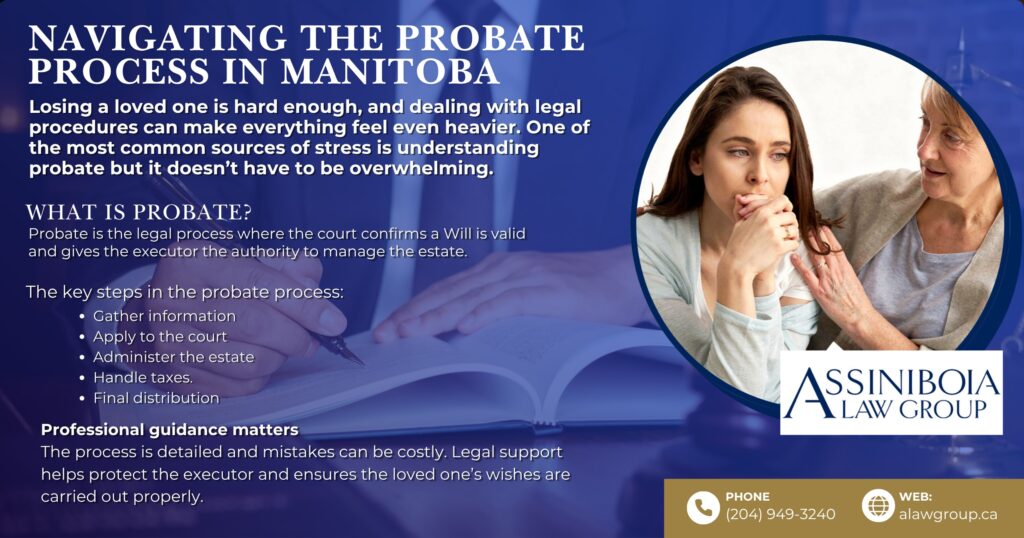
Navigating the Probate Process in Manitoba
By: Brent C. Buss (B.A. (Adv.), LL.B.)
I often find myself guiding families through some of their most difficult times. One of the most frequent sources of stress and confusion after the passing of a loved one is understanding and navigating the probate process. It is a period often marked by grief, complicated by legal procedures that seem, at first glance, like an insurmountable administrative burden.
My goal in this article is to demystify probate, break it down into manageable steps, and offer a practical roadmap for anyone facing this responsibility. In Manitoba, our probate laws are structured to ensure a fair and efficient transition of assets, but knowing what is expected of you as an executor or administrator is the first step toward peace of mind.
This guide is designed from a practical standpoint, providing a clear path from the initial steps following a death to the final distribution of the estate.
Understanding Probate: The Core Concept
In essence, probate is the legal process of “proving” a Will to the court’s satisfaction. It validates that the document presented is the last, true Will of the deceased.
Once the Will is probated, the Court of King’s Bench issues a court order known as “Letters of Probate.” This critical document grants the Executor named in the Will the official authority to manage the deceased’s estate, including accessing bank accounts, selling property, and, crucially, paying any outstanding debts before distribution.
In Manitoba, if someone dies without a valid Will (intestacy), a different but similar process occurs. Someone, typically a close relative, must apply for “Letters of Administration.” This grants them the legal authority to administer the estate according to the laws of intestacy in the province.
Is Probate Always Necessary?
It’s important to understand that not every asset must go through probate. In Manitoba, certain assets pass directly to the new owner without the need for court verification:
- Joint Ownership with Right of Survivorship: If a home, a bank account, or other investments are held in joint tenancy (e.g., between spouses), the surviving owner automatically becomes the sole owner upon the other owner’s death.
- Designated Beneficiaries: Certain assets, such as life insurance policies, Registered Retirement Savings Plans (RRSPs), and Tax-Free Savings Accounts (TFSAs), allow the owner to name a direct beneficiary. These assets bypass the estate entirely and are paid directly to the named individual.
Note: Joint accounts can sometimes be complex. If a joint account was set up merely for convenience (like for a child to help an aging parent manage bills) rather than with the intent of creating a right of survivorship, those funds might still be considered part of the estate. Consulting us in these situations is highly recommended.
Your Step-by-Step Roadmap to Probate in Manitoba
The entire probate process can take anywhere from a few months to more than a year, depending on the complexity of the estate. Here are the essential phases:
Phase 1: Preparation and Investigation
This is the immediate, information-gathering stage. As the named Executor (or potential Administrator), your first tasks are:
- Locate the Will: Ensure it is the original, last, and valid Will.
- Appraise and Catalogue Assets: Compile a detailed inventory of everything the deceased owned. This includes real estate (e.g., the family home, a cabin), bank accounts, investments, vehicles, personal belongings, and any debts or liabilities.
- Identify Beneficiaries: Make a complete list of everyone named in the Will (or who would inherit under The Intestate Succession Act if there is no Will).
Phase 2: Applying for Probate or Administration
This is the heart of the legal process, and it begins by filing the necessary documents with the Court of King’s Bench.
- Preparation of Court Forms: You must complete specific forms as required by the Manitoba Court of King’s Bench. This is where precision matters; errors in documents will be rejected and will cause delays.
- Notification: All beneficiaries and anyone who would have inherited had there been no Will must be formally notified of the application.
- Filing the Application: The complete set of documents, including the original Will (if applicable), is filed at the appropriate court centre of the Court of King’s Bench.
Phase 3: Administration and Management
Once the court reviews and approves your application, you will receive “Letters of Probate” or “Letters of Administration.” Now, your true work begins. As the Executor/Administrator, you have the authority to:
- Access and Transfer Funds: Close bank accounts and transfer funds to a new “Estate Account.” This account should be used for all estate-related income and expenses.
- Manage Assets: Ensure property is secured and insured. If required by the Will (or if necessary for distribution), you might sell real estate, vehicles, or securities.
- Address Debts and Obligations: This is a vital step. You must pay all funeral and estate expenses, personal debts of the deceased (e.g., credit cards, loans), and final taxes from estate assets.
Crucial Advice for This Phase: Advertising for Creditors
To protect yourself from personal liability for any unknown debts of the deceased, it is highly recommended to place a Notice to Creditors in a local newspaper and the Manitoba Gazette. This provides a legal deadline (often 30-90 days) for creditors to come forward. If you distribute the estate before doing this and a creditor subsequently emerges, you could be held personally responsible for the debt.
Phase 4: Taxes
Taxes are perhaps the most complex part of the process. An executor might have to file one or more returns:
- T1 Final Return: This covers the income the deceased earned from January 1st of the year they died up until the date of death.
- T3 Trust Income Tax Return: This covers any income the estate earned (interest, dividends, rental income) from the date of death until the final distribution of the estate. This return is filed annually as long as the estate remains open.
- Final Clearance Certificate: Before you distribute the bulk of the estate to beneficiaries, it is essential to obtain a “Clearance Certificate” from the Canada Revenue Agency (CRA). This certificate confirms that all income taxes have been paid and assessed. Warning: Without this, you as the executor could face personal liability for any taxes the CRA may later discover are owing. This certificate can take several months to receive.
Phase 5: Accounting and Distribution
Before beneficiaries receive their share, you must provide them with a full accounting of how the estate was handled. This includes:
- Statement of Receipts and Disbursements: A detailed ledger showing all money that came in and went out of the Estate Account.
- Schedule of Assets and Liabilities: A final inventory of the estate’s status.
- Approval of Beneficiaries: All beneficiaries must approve these accounts (and, optionally, your request for executor compensation/fees, if any) by signing Releases. A Release protects you from future claims.
- Final Distribution: Once all approvals are received, all debts are paid (including final taxes), and the Clearance Certificate is in hand, you may finally distribute the assets to the beneficiaries according to the Will or the rules of intestacy.
A Closing Note on Seeking Guidance
The probate process in Manitoba is defined, step-by-step, but executing it flawlessly requires attention to detail, time, and careful management. It is easy to make a mistake in court filings, overlook a tax obligation, or expose oneself to liability.
I strongly advise anyone acting as an executor to seek legal and financial counsel. Our role is to handle the legal complexities, from drafting court documents to advertising for creditors and preparing final releases, allowing you the space to focus on your family.
The probate journey is about more than just managing assets; it is about honoring a life and ensuring their final wishes are carried out respectfully and legally. When you are ready, our team at Assiniboia Law Group is here to guide you every step of the way.